
Unified Operating Model After a Merger
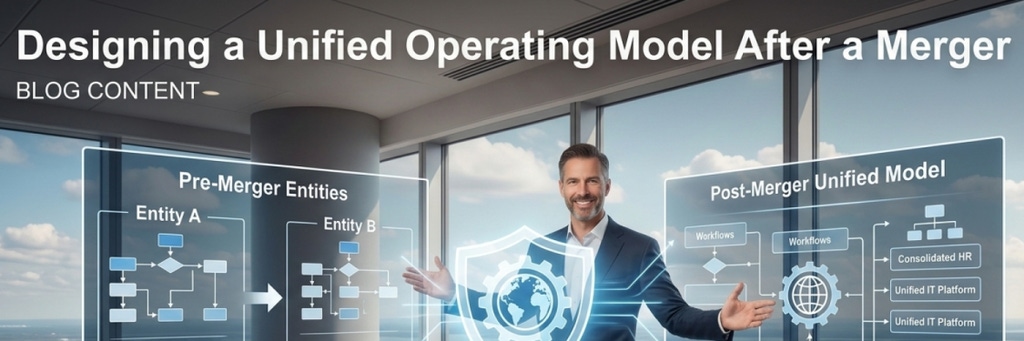
Designing a Unified Operating Model After a Merger: A Strategic Guide for Success
Mergers and acquisitions represent pivotal moments in corporate history, promising growth, market expansion, and competitive advantages. However, the statistics tell a sobering story: studies consistently show that 70-90% of mergers fail to deliver their expected value. The primary culprit? Poor integration execution, particularly the failure to design and implement a unified operating model that brings together the best of both organizations.
Creating a unified operating model after a merger isn’t just about combining two companies—it’s about architecting a new organizational DNA that leverages strengths, eliminates redundancies, and creates a foundation for sustained growth. This process requires strategic thinking, meticulous planning, and flawless execution.
Understanding the Unified Operating Model Framework
A unified operating model serves as the blueprint for how a merged organization will function, make decisions, and deliver value to customers. Unlike simple organizational charts or process maps, an operating model encompasses the complete ecosystem of how work gets done, including organizational structure, processes, technology, governance, and culture.
The unified operating model addresses fundamental questions that every merged organization must answer: How will decisions be made? What processes will we standardize versus customize? How will we allocate resources? What technology platforms will support our operations? How will we measure success?
The complexity of designing a unified operating model stems from the need to balance multiple competing priorities. Organizations must preserve what made each company successful while eliminating inefficiencies and creating new capabilities. This requires deep understanding of both organizations’ strengths, weaknesses, and cultural nuances.
Successful merger synergies realization depends heavily on getting the operating model right. When done well, a unified operating model becomes the engine that drives cost savings, revenue growth, and competitive differentiation. When done poorly, it becomes a source of confusion, inefficiency, and employee frustration.
Core Components of a Unified Operating Model
Organizational Structure and Governance
The organizational structure forms the backbone of any unified operating model. This involves determining reporting relationships, decision-making authority, and accountability frameworks. The challenge lies in creating a structure that eliminates duplication while preserving essential capabilities from both organizations.
Effective governance structures establish clear decision rights and escalation paths. This includes defining which decisions can be made locally versus centrally, establishing approval thresholds, and creating mechanisms for resolving conflicts. The merger integration framework should specify governance bodies, their composition, and their decision-making authority.
Many organizations struggle with organizational integration after merger because they focus too heavily on senior leadership roles while neglecting middle management structures. A comprehensive approach addresses all organizational levels and ensures clear communication channels throughout the hierarchy.
Process Standardization and Optimization
Process integration represents one of the most complex aspects of operating model design. Organizations must evaluate existing processes from both companies, identify best practices, and design new standardized processes that capture the benefits of both approaches.
The operating model design should prioritize processes that directly impact customer experience and operational efficiency. This includes core business processes like order management, customer service, and financial reporting, as well as support processes like human resources and procurement.
Process standardization efforts must balance efficiency gains with local market requirements. While standardization drives cost savings and operational consistency, some processes may require customization to meet specific market needs or regulatory requirements.
Technology Integration and Harmonization
Technology integration often represents the most visible and expensive aspect of post merger integration. The unified operating model must specify which technology platforms will be retained, which will be retired, and what new capabilities need to be developed.
A successful merger integration strategy addresses both immediate integration needs and long-term technology vision. This includes data integration, system interfaces, and user experience considerations. Organizations must also plan for the transition period when multiple systems may operate in parallel.
Technology decisions should support the overall operating model rather than drive it. While technology constraints may influence certain design choices, the operating model should be designed based on business requirements first, with technology solutions selected to support those requirements.
Cultural Integration and Change Management
Cultural integration represents perhaps the most challenging aspect of creating a unified operating model. Each organization brings its own values, behaviors, and ways of working that must be thoughtfully blended into a new corporate culture.
The operating model should explicitly address cultural elements such as communication styles, decision-making approaches, and performance expectations. This includes defining new behavioral norms and establishing mechanisms for reinforcing desired cultural attributes.
Change management becomes critical during this phase, as employees from both organizations must adapt to new ways of working. The merger integration framework should include comprehensive communication plans, training programs, and support mechanisms to help employees navigate the transition.
Connecticut Perspective: Hartford and Fairfield County
In Hartford, Greenwich, Westport, New Haven, and across Fairfield County, many lower-middle-market and mid-market deals involve owner-led businesses that have grown around the founder’s habits, not a formal operating model. After a merger, buyers in Connecticut often need faster reporting, tighter controls, and clearer decision rights to support lender covenants and post-close growth. A unified model also helps preserve customer relationships during leadership transition.
Implementation Framework for Success
Phase 1: Assessment and Design
The implementation process begins with a thorough assessment of both organizations’ current operating models. This involves documenting existing structures, processes, technologies, and cultural attributes. The assessment should identify strengths to preserve, weaknesses to address, and opportunities for improvement.
During the design phase, organizations should engage stakeholders from both companies to ensure the new operating model reflects the best thinking from across the merged entity. This collaborative approach helps build buy-in and ensures important considerations aren’t overlooked.
The design process should result in detailed blueprints that specify exactly how the new organization will operate. This includes organizational charts, process flows, technology architectures, and governance frameworks. The level of detail should be sufficient to guide implementation teams and measure progress.
Phase 2: Pilot and Validation
Before full-scale implementation, organizations should pilot key elements of the new operating model in controlled environments. This allows for testing assumptions, identifying issues, and refining approaches before broader rollout.
Pilot programs should focus on high-impact, high-risk areas where early validation is most valuable. This might include critical customer-facing processes, complex technology integrations, or areas where cultural differences are most pronounced.
The validation process should include both quantitative metrics and qualitative feedback. Organizations should measure operational performance, employee satisfaction, and customer impact to ensure the new operating model is delivering expected benefits.
Phase 3: Full Implementation and Optimization
Full implementation requires careful orchestration of multiple workstreams, each focused on different aspects of the operating model. Project management becomes critical to ensure coordination across workstreams and adherence to timelines.
Implementation should follow a logical sequence that minimizes business disruption while maximizing early wins. This often means starting with back-office functions before moving to customer-facing processes, or implementing structural changes before process changes.
Continuous optimization should be built into the implementation approach. As teams gain experience with the new operating model, they’ll identify opportunities for improvement that should be captured and implemented systematically.
Overcoming Common Integration Challenges
Managing Complexity and Scope
One of the biggest challenges in designing a unified operating model is managing the sheer complexity and scope of the effort. Organizations often underestimate the interconnectedness of different operational elements and the ripple effects of changes.
Successful organizations break down the complexity into manageable components while maintaining sight of the overall vision. This requires strong program management capabilities and clear communication about how different workstreams connect and depend on each other.
The merger integration strategy should include explicit mechanisms for managing scope creep and ensuring that the operating model remains focused on core objectives rather than trying to solve every operational challenge simultaneously.
Balancing Speed and Quality
Post merger integration faces constant pressure to move quickly and realize synergies as soon as possible. However, rushing the operating model design can lead to poor decisions that create long-term problems.
Organizations must find the right balance between speed and quality by focusing on high-impact decisions first and deferring less critical elements. This requires clear prioritization criteria and the discipline to stick to priorities even when stakeholders push for additional scope.
Quick wins should be identified and pursued where possible, but not at the expense of fundamental operating model integrity. Sometimes the fastest path to long-term success requires taking more time upfront to get the foundation right.
Maintaining Business Performance
Designing and implementing a unified operating model while maintaining business performance requires careful planning and execution. Organizations must ensure that customer service levels, operational efficiency, and financial performance don’t suffer during the transition.
This often requires running parallel operations during transition periods, which increases costs and complexity but protects business performance. The additional investment is usually justified by avoiding customer defection and operational disruptions.
Communication with customers, suppliers, and other stakeholders becomes critical during this period. Stakeholders need to understand what changes are happening and how they might be affected, while being reassured that service levels will be maintained.
Best Practices for Unified Operating Model Success
Start with Clear Vision and Principles
Successful operating model design begins with a clear vision of what the merged organization is trying to achieve and the principles that will guide decision-making. This vision should be specific enough to provide direction but flexible enough to accommodate learning and adaptation.
The vision should address both financial objectives and operational capabilities. While cost synergies often drive merger decisions, the operating model should also focus on revenue synergies and competitive differentiation opportunities.
Principles should be established early and communicated broadly to ensure consistent decision-making across all workstreams. These principles might address topics like customer focus, employee treatment, risk management, and cultural values.
Engage Stakeholders Throughout the Process
Stakeholder engagement is critical for both the quality of the operating model design and the success of implementation. Employees from both organizations bring valuable insights about what works, what doesn’t, and what customers care about.
Engagement should be structured and purposeful rather than just consultative. Stakeholders should have real influence on design decisions and clear feedback on how their input is being used. This builds ownership and commitment to the new operating model.
Communication should be frequent, transparent, and two-way. Stakeholders need regular updates on progress and decisions, while leadership needs ongoing feedback about how the changes are being received and what issues are emerging.
Measure Progress and Adapt
Successful operating model implementation requires robust measurement and the willingness to adapt based on results. Organizations should establish clear metrics for both implementation progress and business performance.
Metrics should cover multiple dimensions including operational efficiency, employee engagement, customer satisfaction, and financial performance. Leading indicators should be identified to provide early warning of potential issues.
Regular review cycles should be established to assess progress, identify issues, and make necessary adjustments. The operating model should be viewed as a living framework that evolves based on experience and changing business conditions.
Conclusion: Building the Foundation for Future Success
Designing a unified operating model after a merger represents one of the most complex and important challenges facing business leaders today. Success requires strategic thinking, detailed planning, and disciplined execution across multiple dimensions of the organization.
The investment in getting the operating model right pays dividends for years to come. Organizations that successfully design and implement unified operating models realize greater synergies, achieve better performance, and build stronger competitive positions than those that rush through integration or neglect operating model considerations.
The key to success lies in treating operating model design as a strategic capability rather than a one-time project. Organizations that build expertise in this area position themselves for success not just in their current merger, but in future growth initiatives and market changes.
As markets continue to evolve and consolidation accelerates across industries, the ability to design and implement unified operating models will become an increasingly important competitive advantage. Organizations that master this capability will be better positioned to grow through acquisition and adapt to changing market conditions.
The journey of creating a unified operating model is challenging, but the destination—a more efficient, effective, and competitive organization—makes the effort worthwhile. With careful planning, stakeholder engagement, and disciplined execution, organizations can successfully navigate this complex process and build the foundation for sustained future success.
Frequently Asked Questions
What is a unified operating model after a merger?
It is the combined company’s blueprint for how work gets done after closing. It defines decision rights, reporting lines, operating processes, technology standards, and governance so the new organization can act as one business instead of two separate legacy firms.
How long does it take to design a post-merger operating model?
Many companies create the initial target-state design during diligence or the first 30 days after closing, then refine it over the next 90 to 180 days. The timing depends on complexity, regulatory requirements, systems overlap, and how much operating change the deal requires.
What should be standardized first after a merger?
Finance, reporting, approvals, payroll, and core customer processes usually come first because they create control, visibility, and a consistent employee and client experience. Once those are stable, leaders can align deeper operational workflows and systems.
Why do merger integrations fail?
Integrations often fail because leaders focus on closing the deal but underinvest in decision rights, culture, and process ownership. If teams keep using separate systems or leadership structures too long, synergy capture slows and employees remain confused about priorities.
If you are planning a merger in Hartford or anywhere in Connecticut, Transworld Business Advisors of Hartford Central can help you map the target operating model, stress-test integration risk, and benchmark your company with a confidential valuation consultation.
Ready For What Comes Next on Your Entrepreneurial Journey?
