
Quality of Earnings Reports in M&A Transactions
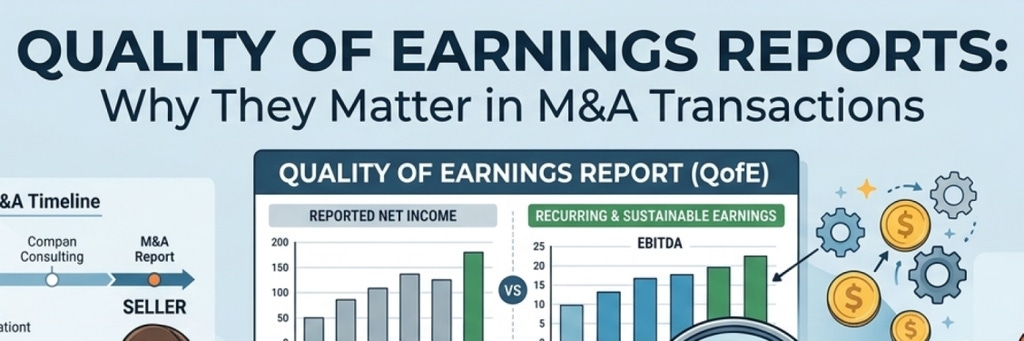
A quality of earnings report significantly impacts deal valuation and negotiations in M&A transactions. When considering a business acquisition, most of us need more than just standard financial statements to make informed decisions.
In fact, a well-done quality of earnings report provides valuable insight into historical operations and highlights areas of concern for the go-forward business. But what is a quality of earnings report exactly? Also known as a QoE report, it compiles accuracy, quality, and sustainability of a company's earnings into a single document. Specifically, it determines whether a business's earnings are accurate and sustainable and whether forecasts of future performance are achievable. Additionally, these reports overcome challenges by providing detailed analysis of normalized earnings, which enhances the understanding of historical performance and future earning potential.
In this article, we'll explore why QoE reports have become standard practice in M&A transactions, how they differ from traditional audits, and what they reveal that could save you from costly investment mistakes.
What is a Quality of Earnings Report?
The quality of earnings (QoE) report serves as a detailed financial analysis that dives deeper than traditional financial statements. Essentially, it evaluates the accuracy, sustainability, and reliability of a company's reported earnings. This specialized assessment examines how a company accumulates its revenues—whether they're cash or non-cash, recurring or nonrecurring—to reveal the true economic picture.
Definition and purpose of QoE
A QoE report is a formal third-party analysis performed by an independent accounting firm that evaluates the true economic earnings of a company. The primary objective is to compile a single document that presents the accuracy, quality, and sustainability of a company's earnings. This analysis adjusts reported earnings for various non-recurring, unusual, or one-time items that may distort financial performance. Furthermore, it provides an objective, defensible view of a company's true economic performance—separating sustainable earnings from accounting distortions and operational noise.
Q of E meaning vs. traditional audits
Unlike standard audits which verify compliance with accounting standards, QoE reports have fundamentally different focuses. Whereas audits ensure numerical accuracy and compliance with Generally Accepted Accounting Principles (GAAP), a QoE digs deeper into the details[14]. Traditional audits are backward-looking and focused on historical compliance, while QoE analyzes are both backward and forward-looking. Moreover, audits typically focus on net income, while QoEs primarily examine EBITDA (earnings before interest, taxes, depreciation, and amortization). This distinction makes QoE reports particularly valuable as they normalize EBITDA by adjusting for one-time events, discretionary spending, and non-operational income.
Why QoE matters in M&A transactions
During M&A transactions, QoE reports have become almost indispensable. For buyers, they provide confidence that pricing assumptions reflect economic reality by validating the company's earnings. These reports help answer a deceptively simple question: How much of the organization's earnings are repeatable, reliable, and transferable post-transaction? Consequently, they allow investors to understand the sustainability of EBITDA used to value the deal, identify risks affecting post-close performance, and reduce uncertainty during negotiations. For sellers, a well-executed sell-side QoE can proactively address issues that might surface late in due diligence, thereby protecting enterprise value and credibility. Since most middle-market M&A transactions determine value based on a multiple of EBITDA, any changes resulting from the QoE can often lead to significant adjustments to the purchase price.
Types of QoE Reports: Buy-Side vs. Sell-Side
In M&A transactions, quality of earnings reports come in two distinct forms, each serving different stakeholders yet containing largely similar content.
Who pays for the report and why
Buy-side QoE reports are commissioned and paid for by potential acquirers to validate their investment decision. These buyers willingly invest in this analysis because it helps them obtain financing or secure approval from board or investment committees.
Conversely, sell-side QoE reports are requested and funded by the selling company. Although this represents an upfront cost for sellers, it's increasingly viewed as a strategic investment rather than an expense. Indeed, sell-side reports have become standard for all but the smallest transactions, making them almost a prerequisite for competitive positioning in the market.
Key differences in objectives
Buy-side QoE reports primarily aim to validate earnings (EBITDA), facilitate understanding of account balances and cash flows, provide clarity on business operations, and support financing efforts.
In contrast, sell-side QoE reports serve to improve closing probability, accelerate transaction timelines, allow sellers to honestly evaluate their business pre-market, identify financial inconsistencies, strengthen negotiating positions, eliminate surprises that could derail deals, support higher valuations, and uncover additional adjustments that might increase value.
When each type is typically used
Sell-side QoE reports are typically prepared before entering the market, ideally three to six months ahead of a sales process. This timing allows sellers to address any issues proactively. Scott Linch, managing partner at Forvis Mazars Capital Advisors, estimates that approximately 90% of PE-backed deals utilize sell-side QoE reports, compared to only about 50% of lower middle-market founder-led businesses.
Buy-side QoE reports occur during the due diligence process. Even when a sell-side report exists, buyers typically perform their own limited procedures to "trust and validate" the seller's QoE. Without a sell-side QoE, buyers start their analysis from scratch, potentially extending the due diligence timeline and giving them more leverage to question financial performance.
Connecticut Perspective: Hartford and Fairfield County
In Hartford, Greenwich, Westport, New Haven, and across Fairfield County, buyers of lower-middle-market companies often rely on QoE work to separate stable cash flow from owner-driven or project-based earnings. That matters in Connecticut’s service, manufacturing, healthcare, and distribution sectors, where customer concentration and working-capital swings can materially affect pricing and lender confidence.
Inside the QoE Process: What’s Analyzed
When diving into a QoE analysis, financial experts meticulously dissect multiple layers of a company's financial and operational structure. The examination goes far beyond surface-level financial statements to uncover the true economic reality.
Revenue recognition and EBITDA adjustments
The cornerstone of any quality of earnings report involves scrutinizing how revenue is recognized and making appropriate EBITDA adjustments. Analysts typically focus on normalizing earnings by identifying and removing non-recurring items, owner-related expenses, and one-time events that might distort financial performance. They'll examine accounting policies to ensure consistent application and identify any aggressive revenue recognition practices that could artificially inflate earnings.
Working capital and cash flow analysis
A thorough examination of working capital trends helps determine whether the target's cash conversion cycle is sustainable. Analysts evaluate accounts receivable aging, inventory turnover, and accounts payable practices. Additionally, they reconcile reported EBITDA with operating cash flow to verify that earnings translate into actual cash generation. This analysis often reveals hidden working capital requirements that could impact post-acquisition performance.
Customer concentration and related-party transactions
Excessive reliance on a few major customers represents a significant risk factor. QoE analysts identify customer concentration issues and evaluate the stability of these key relationships. Simultaneously, they scrutinize related-party transactions that might not continue after acquisition, such as below-market rent from owner-occupied properties or family members on payroll who don't provide substantive services.
Proof of revenue and proof of cash
Verification procedures include tracing reported revenue to supporting documentation like contracts, invoices, and shipping records. Likewise, cash receipts are verified against bank statements to confirm the integrity of reported transactions. This forensic approach helps identify potential phantom revenue or circular transactions.
Operational risks and management quality
Finally, analysts assess the quality of management information systems, evaluate the depth of the leadership team, and identify key person dependencies. They'll examine operational metrics alongside financials to determine whether reported performance metrics align with operational realities. This holistic view helps buyers understand both financial results and the operational infrastructure producing them.
Common Red Flags Found in QoE Reports
Identifying red flags in quality of earnings reports provides crucial insights for investors before finalizing M&A transactions. These warning signs often reveal underlying issues that could significantly impact valuation and future performance.
Aggressive accounting practices
QoE reports typically uncover questionable financial management through inadequate reserves for bad debt, contingent liabilities, or impaired assets. Notably, lower-quality earnings may stem from aggressive accounting or overly optimistic financial forecasting. Hence, examining how a company tracks inventory, manages costs of goods sold, and maintains internal controls becomes critical in identifying potential manipulation.
Improper capitalization or revenue recognition
Among the most serious red flags is improper capitalization of expenses—recording costs as assets rather than expenses to artificially inflate earnings. Historical examples include Waste Management (capitalizing environmental remediation costs), WorldCom (capitalizing "line costs" totaling $11 billion), and AOL
(capitalizing marketing expenses). Similarly, revenue recognized too early or too aggressively distorts the financial picture. Subsequently, these practices make earnings appear stronger than reality.
Unreported liabilities or legal risks
Undisclosed obligations often lurk beneath surface-level financials. These include unrecorded liabilities such as accrued vacation time or looming warranties, pending litigation claims, deferred maintenance creating hidden future costs, and inventory valued at cost despite market crashes. Proof of cash gaps—discrepancies between reported revenue and actual bank deposits—also signal potential problems.
Customer concentration and disengaged management
Customer concentration risk occurs when significant revenue depends on few clients—sometimes 30-40% from top accounts. This dependency creates vulnerability if key customers leave. Alongside this, disengaged management teams and excessive owner perks buried in operating expenses further undermine business value. Obviously, these factors make earnings less predictable and sustainable post-acquisition.
Conclusion
Quality of earnings reports stand as vital tools for anyone involved in M&A transactions. Throughout this article, we've seen how these specialized financial analyzes reveal far more than what appears on standard financial statements. Unlike traditional audits that focus primarily on compliance with accounting principles, QoE reports dig deeper, examining the sustainability and quality of a company's earnings.
Undoubtedly, both buyers and sellers benefit significantly from these reports. Buyers gain confidence that their valuation assumptions reflect economic reality, while sellers can proactively address potential issues before they derail negotiations. The difference between buy-side and sell-side reports might seem subtle at first glance; however, their timing and objectives serve distinctly different purposes in the transaction process.
Most compelling evidence suggests that QoE analyzes have become standard practice because they uncover what truly matters – whether earnings are repeatable, reliable, and transferable after the transaction closes. After all, EBITDA adjustments, revenue recognition practices, working capital trends, and customer concentration all affect the sustainable earning power of a business.
Red flags identified during this process, such as aggressive accounting practices or improper revenue recognition, can save buyers from costly mistakes. Similarly, sellers who commission their own QoE reports can identify and address these issues before entering the market, potentially preserving millions in enterprise value.
Before finalizing any M&A transaction, understanding the quality of earnings provides essential clarity. Though QoE reports require investment, they ultimately reduce risk and uncertainty for all parties involved. While no analysis can guarantee success, quality of earnings reports have certainly earned their place as indispensable tools in the M&A toolkit.
Frequently Asked Questions
What is a quality of earnings report in simple terms?
It is a detailed review of a company’s earnings to show how much profit is truly recurring and how much is distorted by one-time, unusual, or nonoperating items. Buyers use it to understand sustainable EBITDA before closing a deal.
Why do buyers ask for a QoE report?
Buyers want to know whether reported earnings will hold up after the transaction. A QoE report can reveal revenue concentration, seasonality, aggressive add-backs, customer churn, and working-capital issues that change price, structure, or deal terms.
Is a QoE report the same as an audit?
No. An audit checks whether financial statements are fairly presented under accounting standards. A QoE report is transaction-focused and asks whether earnings are normalized, sustainable, and suitable for valuation in a sale or acquisition.
When should a seller get a QoE report?
Sellers should consider a QoE report before going to market or early in diligence if a buyer requests one. Doing it sooner helps clean up add-backs, anticipate lender questions, and reduce the chance of a price retrade later.
If you are preparing to sell or buy a Connecticut business, Transworld Business Advisors of Hartford Central can help you review earnings quality, valuation, and deal readiness. Request a confidential consultation or business valuation today.
Ready For What Comes Next on Your Entrepreneurial Journey?
