Why Poor Data Integration Plans Cost M&A Deals Millions: Real Numbers Revealed
How Weak Data Integration Strategy Destroys Synergies and Delays Value Capture
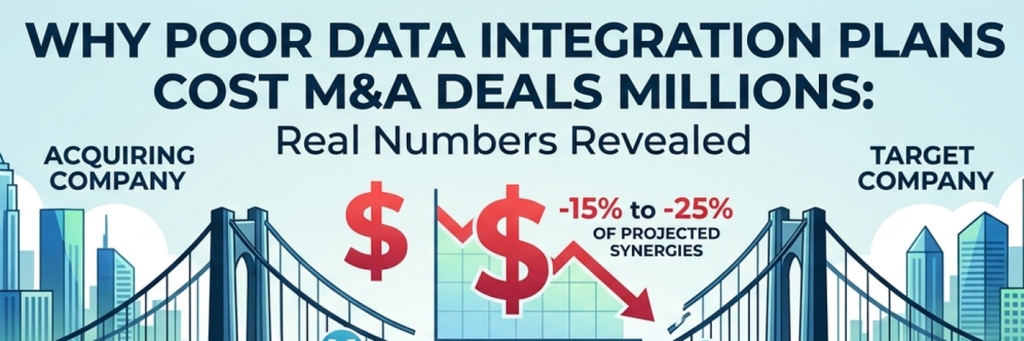
Why Poor Data Integration Plans Cost M&A Deals Millions: Real Numbers Revealed
Data integration plans can make or break modern M&A deals. In 2023, we saw a notable uptick in M&A activity, with a 15% increase in deal volume compared to the previous year. However, behind many failed mergers lies a shocking truth: poor data quality costs an average company $15 million annually.
The consequences of inadequate data analytics in M&A are even more alarming. Studies show that misinformed due diligence or poorly planned integration can destroy millions, sometimes even billions, of dollars in anticipated synergy. Additionally, just 3% of the data in a business enterprise meets quality standards, creating significant challenges when companies attempt to merge systems and processes. Consequently, many mergers and acquisitions are subsequently criticized for insufficient, inaccurate, or untimely information.
In this article, we'll examine why data integration is crucial for M&A success and provide real-world examples of integration failures that cost companies millions. Furthermore, we'll explore how developing a comprehensive data integration project plan can significantly improve outcomes. Whether you're looking for a data integration plan template or specific examples of successful implementation, this guide will help you avoid the pitfalls that have derailed countless promising mergers.
Why Data Integration Is a Make-or-Break Factor in M&A
In mergers and acquisitions, organizations aren't just buying businesses—they're acquiring new systems and data that can become either powerful assets or dangerous liabilities. A robust data integration plan primarily determines whether an M&A deal succeeds or fails.
How data impacts valuation and synergy realization
At the foundation of every successful M&A transaction lies accurate data. During due diligence, buyers must extensively review operational data before finalizing any deal, including sales records, revenue trends, and customer retention metrics. Without clear and trustworthy information, establishing an accurate company valuation becomes virtually impossible.
Quality data must be accurate (with clearly identified and verifiably tracked KPIs), consistent (maintained using reliable patterns), available (accessible and understandable), and secure (protected against breaches). In contrast, ambiguous record-keeping, inconsistencies, and data gaps serve as red flags for potential buyers.
Organizations often overestimate synergies and underestimate integration efforts. Consider this reality: what appears as a 40% customer base growth on paper might actually be only 20% after proper data matching reveals that 17% of customers exist in both CRMs, 4% have slightly different names but match on email or phone, and 3% are duplicates within one system. Such discrepancies dramatically affect growth projections, sales coverage plans, and revenue synergy calculations.
Examples of failed M&A due to poor data integration
Failed data integration has derailed numerous promising mergers. Notably, when Bank of America acquired Countrywide in 2008 for $2 billion, inadequate financial due diligence resulted in the bank essentially purchasing bad debt. The acquisition ultimately cost $50 billion—25 times the initial purchase price.
The 2005 Sprint-Nextel merger ($35 billion) collapsed partly due to technology incompatibility between Sprint's CDMA network and Nextel's iDEN network, leading to costly integration challenges and massive customer losses. By 2008, Sprint had written off most of the deal's value.
In fact, studies reveal that 47% of deals that fail do so primarily because of inadequate strategic planning and execution. Poor IT integration specifically has become fundamental to avoiding M&A failures. The stakes are exceptionally high, yet the timeline for proper integration is often dangerously short.
8 Real-World Data Integration Failures That Cost Millions
Behind many failed M&A deals lurk data integration failures that silently destroy value. These real-world examples illustrate how seemingly technical issues translate directly to financial losses.
1. Duplicate customer records inflating synergy estimates
What appears as a 40% customer base growth on paper often shrinks dramatically after proper data matching reveals overlapping customers. In typical acquisitions, roughly 17% of customers exist in both companies' CRMs, while another 7% are either duplicates or slight variations with matching contact details.
These inflated numbers directly impact revenue projections and valuation models.
2. Incompatible data schemas delaying system migration
When merging companies have different systems with incompatible data structures, integration timelines extend from months to years. Moreover, 70-90% of mergers fail specifically due to technology integration problems. This delay creates a cascade of additional costs including extended licensing fees, consultant expenses, and lost productivity.
3. Missing financial data affecting due diligence accuracy
Financial records with gaps, inconsistencies, or missing documentation undermine the entire M&A process. Notably, when incomplete records surface during diligence, the immediate effect is reduced valuation, extended timelines, and diminished buyer trust. The HP-Autonomy case exemplifies this problem—HP wrote down $8.8 billion of an $11 billion acquisition after discovering accounting irregularities.
4. Poor master data management causing reporting errors
Without standardized master data management, organizations operate with fragmented systems and contradictory information. Furthermore, ineffective MDM leads to bloated inventories, decision paralysis, and millions in lost revenue. Conflicting product categorizations affect everything from analytics to supply chain efficiency.
5. Lack of entity resolution tools in CRM systems
Entity resolution—the process of identifying and linking records that refer to the same entities—is critical for CRM consolidation. Meanwhile, business records often differ through variations like "Hewlett Packard" versus "HP" or presence/absence of corporate designators. Without proper resolution tools, organizations cannot construct accurate customer profiles.
6. Misaligned product hierarchies skewing revenue forecasts
Inconsistent product taxonomies between merging companies create reporting nightmares. Ultimately, a weak product hierarchy affects inventory management, analytics, and customer segmentation. This misalignment leads to flawed revenue forecasts and synergy projections.
7. Manual data matching leading to compliance violations
Manual processes for reconciling customer or transaction data introduce compliance risks. Actually, 40% of acquiring companies discover cybersecurity problems during post-acquisition integration. These compliance breaches can result in significant regulatory penalties and legal expenses.
8. Overlooked dark data hiding operational risks
Approximately 85% of corporate data is unstructured or "dark" data that typical M&A due diligence processes fail to identify. Firstly, this hidden data typically contains 42% confidential information and 10% personally identifiable information. The Marriott-Starwood breach illustrates this risk—Marriott failed to detect unencrypted passport numbers during acquisition, leading to massive penalties.
How Data Analytics Supports Smarter M&A Decisions
Advanced data analytics tools are rapidly changing M&A decision-making processes. Currently, approximately 97% of corporate and private equity leaders use advanced analytics or AI for due diligence and M&A decisions.
Using predictive analytics to model integration scenarios
Predictive analytics allows companies to forecast post-acquisition performance by applying machine learning to historical transaction data. Digital twins enable leaders to model IT systems, business processes, and workforce dynamics before committing resources. Through scenario planning, executives can examine efficiency, capacity, and scalability to determine which processes integrate seamlessly and where redundancies might cause friction.
Data-driven risk assessment in legal and compliance
Data-driven risk analysis equips legal and compliance teams to flag potential issues and quantify exposure. AI-powered document analysis extracts key information from contracts, financial statements, and operational reports, allowing teams to focus on strategic evaluations rather than data gathering. Particularly in AI-related acquisitions, acquirers must address complex legal risks related to intellectual property, data privacy, and regulatory compliance.
Customer overlap analysis using entity resolution
Without accurate entity resolution, acquirers often underestimate customer base overlap. For example, what looks like 40% customer growth on paper might actually be only 20% after proper matching. Obviously, shared accounts frequently have different pricing agreements, sales contacts, and contract structures across merging organizations. Effective overlap analysis requires transaction-level mapping, revenue segmentation, and contract harmonization to identify cross-sell opportunities and standardize pricing structures.
Best Practices for Building a Data Integration Plan
Successful M&A deals hinge on meticulous data integration planning. According to research, over 40% of data migration projects fail to meet their timelines or exceed budgets by an average of $0.30 million per data set. Given that typical M&A deals involve dozens of data sets, these costs accumulate rapidly.
Creating a data integration project plan example
An effective M&A integration plan explicitly outlines how and when major resources, assets, and processes will be combined. Successful plans follow a proven methodology (playbook) that makes the integration process logical and achievable for both organizations. Start by establishing weekly cadences between Integration Management Office (IMO) teams to promote daily progress, escalate risks, and resolve problems promptly.
Standardizing taxonomies and data formats
Standardization ensures data consistency, accuracy, and meaning across the organization. By default, the acquired company's data must align with the buyer's data model to ensure consistency and operational efficiency. Nevertheless, evaluate the acquired company's data model for potential value that could enhance the buyer's existing framework.
Embedding governance and quality protocols
Effective data governance becomes part of a company's DNA when integrated into daily operations. Accordingly, create governance councils for oversight and strategic decisions while defining domain-specific roles for efficiency. Use technology to scale governance by implementing data catalogs, quality management systems, and policy engines.
Using a data integration plan template for execution
Integration templates help simplify and expedite integration work. Chiefly, these templates provide structure for many integration teams including finance, HR, IT, marketing, legal, procurement, culture, and change management. Tools like eMerger software offer over 80 post-merger integration tools that can be downloaded and customized for specific acquisitions.
Conclusion
Data integration ultimately determines whether millions in M&A value materialize or evaporate. Throughout this analysis, we've seen how poor data quality creates cascading effects across the entire acquisition lifecycle. Undoubtedly, the $15 million annual cost of substandard data management represents just the beginning of potential losses.
The stark reality remains that 97% of business data fails to meet quality standards, creating significant challenges during system integration. Therefore, companies must shift from viewing data integration as a technical afterthought to recognizing it as a strategic imperative driving deal valuation and synergy realization.
Real-world failures demonstrate this principle clearly. Bank of America's $50 billion loss from the Countrywide acquisition and Sprint-Nextel's network incompatibilities show how data integration problems manifest as financial catastrophes. Additionally, the eight failure patterns we've examined—from duplicate customer records to overlooked dark data—reveal how seemingly technical issues translate directly to significant financial losses.
The good news? Forward-thinking companies now employ data analytics to model integration scenarios before finalizing deals. Predictive analytics, digital twins, and entity resolution tools allow acquirers to identify potential problems early while quantifying both risks and opportunities.
Building a comprehensive data integration plan remains essential for avoiding costly pitfalls. This plan should include standardized taxonomies, embedded governance protocols, and structured templates that guide the integration process. After all, a well-executed data strategy not only prevents losses but also accelerates value creation.
Data integration excellence determines which companies capture the full potential of their acquisitions and which face disappointing outcomes. Organizations that prioritize this critical function will find themselves positioned for M&A success, while those that neglect it risk joining the long list of cautionary tales where millions—or even billions—vanished due to preventable integration failures.
Ready For What Comes Next on Your Entrepreneurial Journey?