Why Some Businesses Never Sell | 7 Common Reasons
For many business owners, selling their company represents the culmination of years, sometimes decades, of hard work. They have invested their time, taken financial risks, built customer relationships, and made countless sacrifices along the way. When the time comes to sell, they naturally expect that someone will recognize the value of what they have built.
Unfortunately, not every business that goes on the market finds a buyer.
Some businesses attract plenty of interest but never receive a serious offer. Others receive offers but struggle to make it through due diligence or financing. In some cases, owners spend months looking for a buyer before deciding to take their business off the market altogether.
The important distinction is that a business can be profitable, well-established, and attractive to potential buyers without necessarily being positioned for a successful sale.
Understanding what prevents businesses from selling can help owners address potential problems before they become obstacles in a transaction.

1. The Asking Price Doesn’t Match What Buyers Can Justify
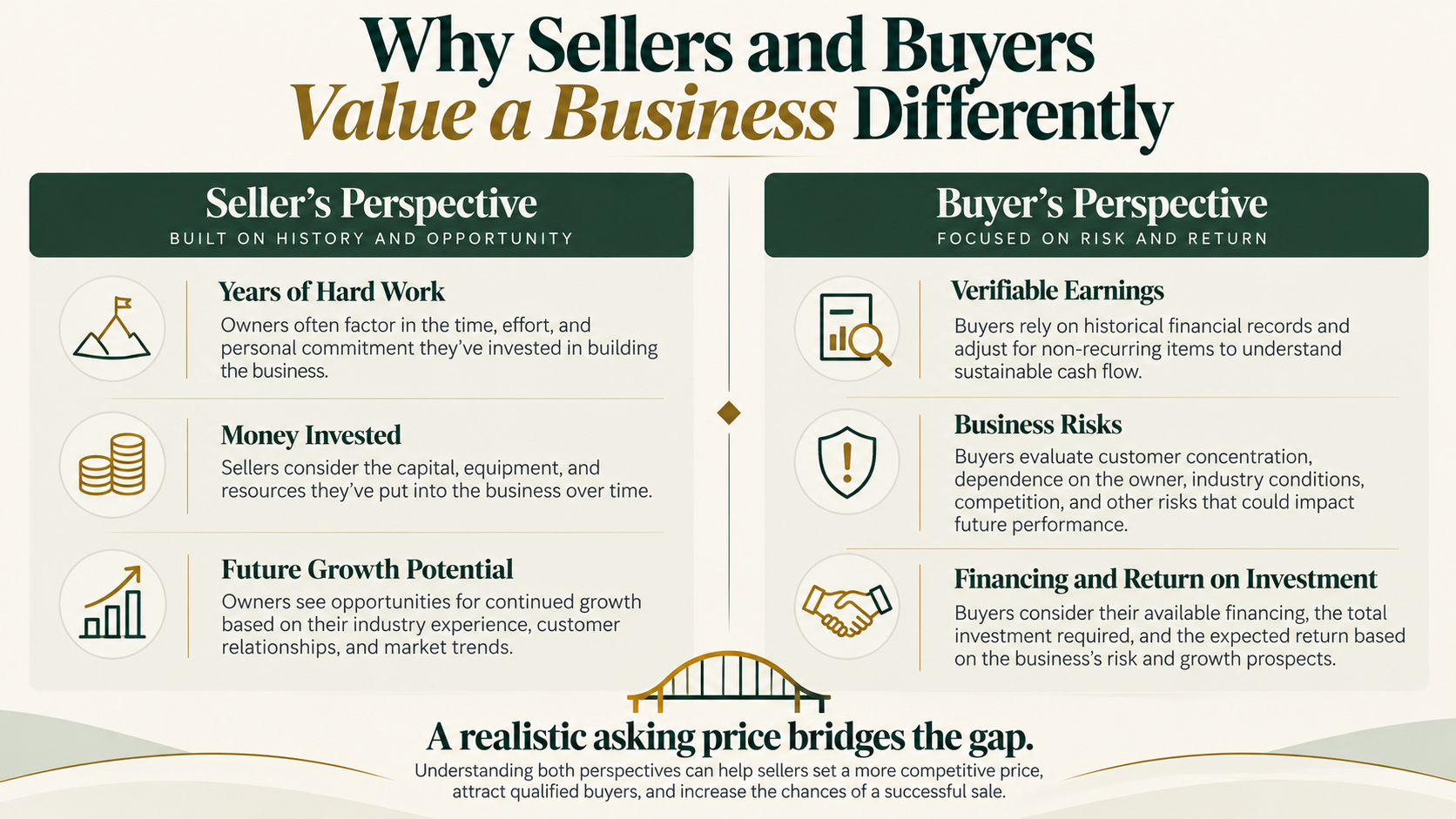
One of the most common obstacles to selling a business is a difference between what the owner believes the business is worth and what buyers are willing and able to pay.
Business owners often associate value with the years they have invested, the reputation they have built, or the amount of money they need to retire comfortably. Those considerations are understandable, but buyers approach valuation differently.
Most buyers of established small businesses focus heavily on financial performance, particularly the cash flow available to support their compensation, debt payments, and a reasonable return on their investment.
For many owner-operated businesses, this means evaluating Seller’s Discretionary Earnings (SDE), which estimates the total financial benefit available to one full-time owner-operator after making appropriate adjustments to reported earnings.
Consider a hypothetical business generating $200,000 in annual SDE. If comparable businesses support a valuation of approximately 2.5 times SDE, the indicated value would be around $500,000.
If the owner insists on asking $900,000 because that is the amount needed for retirement, buyers may have difficulty justifying the price, regardless of how much they like the business. Unfortunately, a seller's needs for retirement have zero relevance to the pricing of a business.
This doesn’t mean every business should sell for 2.5 times earnings. Valuation multiples vary considerably depending on the industry, financial performance, risk, growth potential, and other factors.
What owners can do: Obtain a realistic business valuation before going to market. Transworld Business Advisors of La Grange does provide valuations. The cost of that valuation will be credited against our commission at close. Understanding how buyers and lenders evaluate a business can help establish an asking price that attracts qualified buyers while protecting the owner’s financial interests. At the very least knowing where a seller currently stands today with market value will help to avoid any shocks to expectations when the business is on the market. Please note, the market will speak LOUDLY as to what the business is worth as inquiries and offers come in.
2. The Business Depends Too Heavily on the Owner
A business may operate successfully for decades because its owner is exceptionally good at what they do. The challenge comes when a buyer begins asking what will happen after that owner leaves.
Imagine a successful HVAC company where the owner handles every estimate, maintains relationships with major customers, schedules technicians, and personally resolves difficult service issues.
The business may generate healthy profits, but a buyer has to consider whether those profits will continue under new ownership.
This concern is particularly relevant in small manufacturing companies, home service businesses, professional services firms, and other businesses where the owner’s personal relationships or technical expertise play a central role.
Buyers want to understand which responsibilities can be transferred to employees, which processes are documented, and how much support the seller will provide after closing.
The more dependent the business is on its current owner, the more uncertainty a buyer may perceive.
What owners can do: Begin delegating responsibilities, documenting procedures, and strengthening employee relationships well before the sale. Even modest improvements can make the business easier for a new owner to operate.
3. The Financial Records Don’t Tell a Clear Story
A business can generate strong cash flow and still struggle to attract serious buyers if its financial records are incomplete, inconsistent, or difficult to understand.
During the sale process, buyers and their lenders typically review several years of financial statements and tax returns. They want to understand how much the business earns, whether those earnings are sustainable, and what expenses will continue after the sale.
Problems often arise when owners have difficulty explaining discrepancies between tax returns and internal financial statements, personal expenses are mixed with business expenses, or financial performance changes significantly from year to year.
For example, an owner may claim that the business generates $250,000 in annual cash flow, but the financial statements initially show only $100,000 in earnings.
There may be legitimate adjustments that explain the difference, such as owner compensation, depreciation, or certain nonrecurring expenses. However, those adjustments need to be reasonable and supported by documentation.
Buyers are generally more comfortable paying for earnings they can verify than for earnings that depend on the seller’s explanations.
What owners can do: Work with an accountant and business broker to organize financial statements, identify supportable adjustments, and prepare a clear explanation of the company’s historical performance. Messy financial records and pricing are the top two reasons that businesses never sell!
4. Buyers See Risks That the Owner Has Learned to Live With
Business owners become accustomed to the challenges of running their companies. Over time, certain risks may feel like normal parts of doing business. Buyers, however, are evaluating those risks for the first time.
A manufacturing company might rely on one customer for a significant portion of its revenue. A distribution business might have several important supplier relationships that are not protected by written agreements. A landscaping company might depend heavily on a few employees who have been with the owner for years.
None of these circumstances automatically makes a business unsellable. However, they can affect how buyers evaluate the opportunity, how much they are willing to pay, and what protections they request in the purchase agreement.
Customer concentration is a particularly important consideration. If one customer accounts for 35% of annual revenue, a buyer may worry about what would happen if that customer stopped placing orders after the acquisition.
Even when the relationship has been stable for many years, the buyer has to evaluate the potential financial impact of losing that account.
What owners can do: Identify major business risks before going to market. Diversifying customers, formalizing important relationships where practical, and developing employee retention strategies can make the business more attractive to prospective buyers.
5. The Business Attracts Buyers Who Cannot Complete the Purchase
Receiving inquiries is not the same as having qualified buyers.
A business listing may generate substantial interest from individuals who like the industry, admire the company, or dream of becoming business owners. However, not everyone who expresses interest has the financial resources, relevant experience, or ability to secure financing.
This distinction becomes particularly important when a buyer intends to use an SBA-backed acquisition loan.
Lenders evaluate the business’s historical financial performance, the proposed transaction, and the buyer’s financial position and qualifications. A buyer may be enthusiastic about the opportunity but unable to obtain the financing necessary to close.
Other buyers may have sufficient capital but lack the operational experience required to run a specialized business successfully.
For example, acquiring a manufacturing operation with complex equipment, technical employees, and specialized customer requirements may require a different background than purchasing a relatively straightforward service business.
When sellers spend months negotiating with buyers who cannot realistically complete the transaction, valuable time can be lost. This is a reason why business brokers can help with the process. Making sure a buyer answers a buyer profile to speak to their experience is important. The business broker should also be vetting these buyers out on the phone.
What owners can do: Establish a buyer qualification process that considers available capital, financing plans, relevant experience, acquisition objectives, and the buyer’s ability to move forward within a reasonable timeframe. Business brokers typically have this process already set up. They get paid when you get paid so they don't want to work with a buyer that can't complete a transaction.
6. Problems Surface During Due Diligence
Finding a buyer and agreeing on a purchase price are important milestones, but they do not guarantee a completed sale.
Once an offer is accepted, the buyer typically begins a more detailed investigation of the business. This process, known as due diligence, allows the buyer to verify the financial, operational, legal, and commercial information presented before the offer.
During this stage, buyers may discover issues involving inventory, equipment condition, outstanding liabilities, customer relationships, employee matters, or contractual obligations.
Some issues are relatively easy to resolve. Others can materially change the economics of the transaction.
For example, suppose a buyer makes an offer based partly on the expectation that the business includes $100,000 in usable inventory. During due diligence, a physical inventory count reveals that the actual amount is substantially lower.
The buyer may request a price adjustment, and the seller may disagree with the proposed reduction. If the parties cannot reach an agreement, the transaction could fall apart.
The underlying problem may not be that the business is unattractive. It may simply be that the information available before the offer did not accurately reflect what the buyer discovered afterward.
What owners can do: Conduct a preliminary review of the business before going to market. Confirm inventory balances, review equipment lists, reconcile financial records, and identify potential issues that buyers are likely to investigate.
Also, this is a reason to make sure due diligence is in a concise window that your business broker is monitoring. Wasting time with due diligence that goes on for weeks only to find out your buyer will not move forward is a drain on sellers as multiple deals can die before eventually getting to the finish line.

7. The Seller Isn’t Fully Prepared for What Selling Involves
Selling a business requires more than finding someone willing to purchase it.
Owners must make decisions about purchase price, financing contingencies, transition assistance, employee communication, noncompete agreements, and numerous other details.
Some sellers discover during negotiations that they are uncomfortable with the amount of information buyers need to review. Others are unwilling to provide transition support, accept reasonable deal protections, or consider adjustments when legitimate issues arise.
There can also be emotional challenges. For someone who has spent 30 years building a company, the business is often much more than a financial asset. It may represent their identity, relationships, and life’s work.
That emotional attachment is understandable, but it can make negotiations difficult when buyers approach the transaction primarily as an investment decision.
A buyer’s request for additional financial information or a price adjustment may feel personal, even when it is part of a normal acquisition process.
What owners can do: Discuss expectations with a business broker, attorney, accountant, and financial advisor before entering the market. Understanding the process, identifying priorities, and deciding where flexibility is possible can help prevent unnecessary disagreements later.
In short, may make sure the seller is prepared to commit to the process of selling their business.
Sometimes the Problem Isn’t the Business. It’s the Deal Structure.
Even when a business is financially attractive and both parties agree on its value, the transaction still needs to work for the buyer, seller, and any lender involved.
Lease assignments, working capital requirements, financing conditions, and the seller’s role after closing can all influence whether a transaction is completed.
Consider a business operating from a leased facility. A buyer may be comfortable with the purchase price and financial performance but unable to obtain acceptable lease terms from the landlord. Without a workable solution, the buyer may not be able to proceed.
In other transactions, a buyer may need additional working capital or request that the seller finance a portion of the purchase price. Depending on the circumstances, a carefully structured seller note or another negotiated arrangement may help bridge the gap.
However, seller financing is not appropriate for every transaction, and owners should understand the financial risks and repayment terms before agreeing to it.
The important point is that a successful sale requires more than agreement on the purchase price. The entire transaction must be workable.
What Should You Do Before Putting Your Business on the Market?
Many of the issues that prevent businesses from selling can be addressed, or at least better understood, before buyers become involved.
Ideally, owners should begin preparing well before they intend to sell. Even those planning to exit within the next year can benefit from reviewing the business through a prospective buyer’s eyes.
That preparation should include an assessment of the company’s financial performance, realistic market value, owner involvement, customer concentration, employee structure, lease obligations, and other factors that may affect a transaction.
It is also important to distinguish between problems that genuinely need to be corrected and issues that simply need to be disclosed, explained, or accounted for in the transaction structure.
Not every business needs to be perfect before it can be sold.
An owner-dependent business may still attract a qualified buyer. A company with concentrated customers may still have substantial value. A business experiencing a temporary decline in revenue may still be an attractive acquisition.
The key is understanding how those circumstances influence buyer expectations and preparing accordingly.
Selling a Business in Chicago and the Surrounding Suburbs
For business owners throughout Chicagoland, the potential buyer pool can include individual owner-operators, local competitors, regional companies seeking expansion, and strategic buyers interested in entering new markets.
Each type of buyer may evaluate the same business differently.
An individual buyer might focus on cash flow, financing requirements, and whether they have the skills to operate the company. A strategic buyer may place greater emphasis on customer relationships, geographic coverage, employees, equipment, or opportunities to combine operations.
Understanding which buyers are most likely to see value in a particular business can influence how the company is positioned and marketed.
At Transworld Business Advisors of La Grange, we work with owners of established businesses throughout Chicago and the surrounding suburbs, helping them understand business valuations, prepare for potential buyer questions, and navigate the complexities of the sale process.
The Bottom Line
Businesses don’t always fail to sell because they lack value. Sometimes the asking price is unrealistic, the financial information is difficult to verify, the buyer cannot secure financing, or an unexpected issue makes the transaction impossible to complete.
In some cases, these problems rise to the surface only after the owner has invested considerable time and effort into selling.
The earlier owners understand what buyers are likely to question, the better prepared they can be to address those concerns.
If you’re considering selling your business, whether in the near future or several years from now, a conversation about its current market position can be a useful starting point.
Transworld Business Advisors of La Grange helps business owners throughout Chicagoland evaluate their options and prepare for a potential sale. Our office can see blind spots within a company or potential transaction for consideration PRIOR to taking the business to market. Contact our office for a confidential conversation about your business, its potential value, and what may be worth addressing before going to market.
What is the most common reason a business doesn’t sell?
Unrealistic pricing is one of the most common obstacles. When an asking price cannot be supported by financial performance, comparable sales, and buyer financing requirements, attracting qualified buyers becomes more difficult. However, poor financial documentation, excessive owner dependency, and unresolved operational risks can also prevent a sale.
Can a profitable business still be difficult to sell?
Yes. Profitability alone does not guarantee that a business will sell. Buyers also evaluate the sustainability of earnings, customer concentration, owner involvement, employee stability, and the ability to finance the acquisition.
What happens if my business doesn’t sell?
An owner may decide to adjust the asking price, improve financial or operational performance, reconsider the deal structure, or temporarily withdraw the business from the market. The appropriate decision depends on why buyers have not moved forward and the owner’s financial and personal objectives.
How can I improve my chances of selling my small business?
Start with a realistic valuation, maintain accurate financial records, reduce unnecessary owner dependency, and identify potential problems before listing the business. Working with experienced transaction advisors can also help owners prepare for buyer qualification, due diligence, financing, and negotiations.
Ready For What Comes Next on Your Entrepreneurial Journey?