Selling Your Business? Why Ignoring Your Business Broker Can Cost You Millions
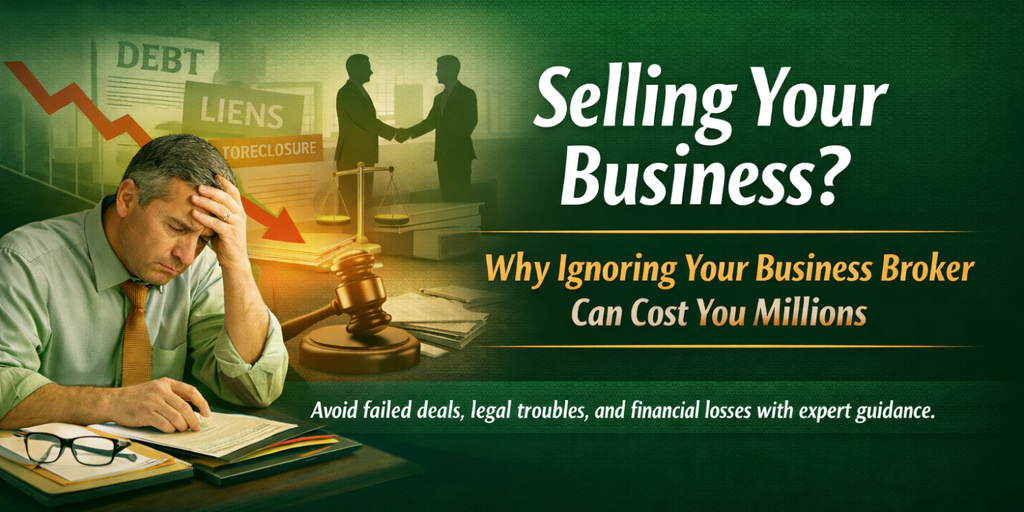
There is a hard lesson I have learned over and over again in this business.
When a seller hires an advisor, agrees to a data-driven valuation, signs the engagement documents, and then later decides to operate outside the process, value almost always gets destroyed. This is almost always the case.
I will explain.
Recently, we were engaged by a restaurant owner. We did what we always do. Discovery. Financial reconstruction. Recasting. Valuation grounded in market data. Packaging. Confidential marketing. Buyer screening. Structured communication.
Like many sellers, the owner began with expectations that were higher than what the financials supported. That is normal. We walked through the numbers together and aligned around a defensible valuation. The business went to market properly positioned.
Then information began to surface that had not been disclosed during discovery.
The seller was under significant personal financial pressure related to medical issues. The timeline they had originally committed to changed. Most of the staff were family members who would not stay after closing. Debt that was described as manageable became more complicated in practice.
None of those issues are fatal by themselves. We handle difficult situations routinely. What becomes fatal is when those realities are not managed within a structured process.
Instead of recalibrating with us, the seller began negotiating directly with a buyer we had already screened and flagged. Our screening had uncovered unusual behavior and a public record of fraud matters. We also knew the buyer had previously acquired a similar business that did not end well. Their operating style was unconventional in ways that created insurance and liability exposure.
Against our advice, the seller negotiated anyway. Instead of driving the transaction, we were along for the ride, playing a support role for whatever came up as a result of thier direct communications.
The deal they agreed to was for less than 40% of the valuation. The buyer dragged diligence far beyond reasonable limits, missed key contractual dates, asked for concessions we would never have granted, and ultimately failed to close. Escrow funds had to be pursued through legal action. Months were lost. The business destabilized.
We then did what advisors often end up doing in these scenarios: we stabilized operations, restructured the narrative, and repackaged the opportunity.
Then it happened again.
Against our advice, against the NDA framework, and against the listing agreement, the seller negotiated another direct deal. This one was even worse — roughly 20% of actual value. The buyer was prepared to close quickly, but UCC-1 liens surfaced. The secured debt exceeded the net proceeds the seller would receive. Even if lenders permitted the sale — which was unlikely — the seller would have walked away in a worse financial position than before.
That deal collapsed as well.
By this point, the majority of our time was no longer focused on creating value. It was focused on cleaning up damage. Coordinating lender hardship discussions. Assisting legal counsel. Preparing documentation to support court action for escrow release. Managing creditor exposure.
It was costly for our firm. More importantly, it may have cost the seller everything.
This is not an isolated story. I have seen versions of this repeatedly. When a seller steps outside the process and negotiates independently, value erodes. Sometimes it is tens of thousands of dollars. Sometimes it is millions.
There are reasons this happens.
- Urgency compresses judgment. When someone is under medical, tax, or cash flow pressure, speed starts to feel more important than structure.
- Confidence is mistaken for competence. A buyer who sounds decisive can appear attractive, even when their history suggests otherwise.
- Experience asymmetry is ignored. We see dozens of transactions. Many sellers will sell one business in their lifetime. When they negotiate alone, they often concede points they do not fully understand — escrow protections, diligence boundaries, lien resolution mechanics, default triggers, working capital adjustments, post-closing liabilities.
- And not to be ignored, incomplete disclosure early in the process compounds later. When material facts are held back — intentionally or not — the strategy is built on partial information. That gap eventually surfaces, usually when leverage is lowest.
The advisory fee is not compensation for “finding a buyer.” It is compensation for protecting enterprise value and managing risk.
- We screen buyers so sellers do not end up in escrow litigation.
- We enforce timelines so deals do not drift into uncertainty.
- We structure terms so lenders, creditors, and lienholders are addressed before closing day.
- We filter out noise so sellers are not negotiating against themselves.
When a seller operates independently, they remove the guardrails but retain the exposure.
The most successful closings we have been part of share one characteristic: alignment. Full disclosure at the beginning. Respect for the process. Clear communication when circumstances change. Discipline around buyer interaction.
Difficult deals can close successfully. Financial distress can be managed. Employee dependency can be structured. Liens can be resolved. But only when the process is respected.
If you are considering selling your business, understand this clearly: independence during a transaction does not increase control. It increases risk.
Structure is not bureaucracy. It is protection.
If you want to maximize value, reduce legal exposure, and close with certainty rather than chaos, engage experienced advisors and stay aligned with them. The cost of doing otherwise is almost always higher than the fee you think you are saving.
We have agreements and processes for a reason. They are written in response to real-world losses we have seen.
Successful closings are rarely accidental. They are disciplined.
Ready For What Comes Next on Your Entrepreneurial Journey?