Hidden Costs of Buying a Business: Working Capital, Inventory, and Beyond

When buyers evaluate a business acquisition, they typically focus on the purchase price. But here's what experienced buyers know: the purchase price is just the beginning.
From working capital needs to equipment upgrades to unexpected transition costs, the total investment required to acquire and operate a business is almost always higher than the sticker price. Industry experts estimate that buyers should budget an additional 25-35% beyond the purchase price to cover the true cost of acquisition for deals under $5 million. Failing to account for these hidden costs can strain your cash flow, limit your options, and even put your new business at risk.
This guide breaks down the costs that often catch first-time buyers off guard—so you can build a realistic budget and enter ownership with your eyes wide open.
Working Capital Requirements
Working capital is the cash you need to fund day-to-day operations: paying employees, covering rent, purchasing inventory, and keeping the lights on while you wait for customers to pay.
Why buyers underestimate working capital
Most buyers assume the business will "pay for itself" from day one. But reality is more complicated. Think of working capital like buying a used car: you agree on a purchase price assuming the car comes with a half tank of gas so you can drive it immediately. If you get the keys and the tank is empty, you're stranded before you even leave the lot. The same principle applies to business acquisitions—you need sufficient working capital on Day One to keep operations running while you transition into ownership.
Common factors that strain working capital include seasonal revenue fluctuations that vary significantly by month or quarter, payment terms that require you to pay suppliers before customers pay you, sales slowdowns during ownership transitions, and unexpected expenses like equipment failures, key employee departures, or delayed customer payments.
How much working capital do you need?
A common rule of thumb is 3-6 months of operating expenses. But the right amount depends on several factors. The business's cash conversion cycle measures how long it takes to turn inventory and receivables back into cash—businesses with longer cycles need more working capital. Seasonality of the industry can dramatically affect needs; retail businesses may need extra cash before the holiday season, while HVAC companies see revenue spikes in summer and winter. Your comfort level with risk also matters, though first-time buyers should err on the side of larger reserves.
Pro tip: Ask the seller for month-by-month cash flow statements for the past two years, not just annual summaries. This reveals the true working capital requirements throughout the business cycle.
Inventory Considerations
If you're buying a business with inventory (retail, wholesale, manufacturing), inventory costs can significantly impact your total investment.
Inventory is sometimes separate from the purchase price
In some cases, inventory is priced separately and added to the purchase price at closing. This can add tens of thousands of dollars—or more—to your total cost.
Watch out for:
Obsolete or slow-moving inventory
Not all inventory is worth its stated value. Negotiate for adjustments on outdated or unsellable items.
Inventory fluctuations
Inventory levels vary throughout the year. Make sure you understand what's "normal" and what you're actually buying.
Verification
Conduct a physical inventory count before closing, not just a review of records. Hire an independent third party if the inventory value is substantial. Discrepancies between recorded and actual inventory levels are red flags for deeper operational issues like theft, poor inventory management, or accounting irregularities.
Transition Costs
The period between closing and full operational independence often comes with its own expenses.
Training and consulting fees
Many deals include a transition period where the seller trains the new owner. But if you need extended support—or outside consulting—expect to pay for it.
Professional fees
Engaging qualified professionals is non-negotiable for a successful acquisition. Legal fees typically cover contract reviews, lease transfers, and entity formation. Accounting fees range widely based on deal complexity: a basic financial review for small deals may cost $2,000 to $5,000, while a comprehensive Quality of Earnings report commonly runs between $10,000 and $30,000 for businesses under $10 million in revenue. More complex deals can easily exceed $60,000 in accounting due diligence alone. While broker commissions are typically paid by the seller, understanding the complete deal structure helps you anticipate all parties' incentives and potential costs.
Licensing and permits
Some licenses and permits don't automatically transfer to new owners. You may need to apply for new ones, which can involve fees and processing time.
System transitions
Transferring or setting up new systems for:
- Payroll
- Point of sale (POS)
- Accounting software
- Customer relationship management (CRM)
Technology and Equipment Upgrades
The equipment and technology you're acquiring may not be in the condition you expect.
Questions to ask during due diligence:
- How old is the major equipment?
- When was it last serviced or upgraded?
- Are there any pending repairs or replacements?
- Is the technology current, or will it need updating?
Budget for near-term upgrades
Even if equipment is functional at closing, consider its remaining useful life. A delivery truck with 150,000 miles may legally operate but is living on borrowed time. A 10-year-old HVAC system in a restaurant may still cool the dining room but is less efficient and more prone to expensive breakdowns. Create an equipment replacement schedule during due diligence, and factor replacement costs into your offer price if critical equipment is near end-of-life.
Marketing and Rebranding Expenses
Ownership transitions often prompt marketing investments:
Customer communication
You'll want to announce the transition and reassure customers. This might include:
- Direct mail or email campaigns
- Updated signage
- Website updates
- Social media announcements
Brand refresh (optional)
Some buyers choose to update the brand, which can include:
- New logo or visual identity
- Updated marketing materials
- Signage changes
Marketing to prevent customer attrition
If customers had a personal relationship with the previous owner, you may need to invest in retention marketing to maintain loyalty.
Employee-Related Costs
Your team is your greatest asset—but transitioning employees can have costs that significantly impact your post-acquisition budget.
Retention incentives
Key employees may need incentives to stay through the transition, particularly if they had strong personal relationships with the previous owner. Retention bonuses or performance incentives can range from several thousand dollars to a percentage of their annual salary. The cost of losing a critical employee during transition—and the subsequent recruiting, training, and lost productivity—far exceeds the investment in retention.
Hiring and training
If key positions are vacant or employees leave during transition, you'll face recruiting costs including job postings, recruiter fees (typically 15-25% of first-year salary), background checks, and extensive training time. Plan for at least two to three months of reduced productivity as new hires get up to speed.
Benefits and compensation review
Employees often expect raises, improved benefits, or updated policies under new ownership. Even if you don't change compensation immediately, you should budget for a comprehensive benefits review and potential adjustments to remain competitive in your market.
Building a Realistic Post-Acquisition Budget
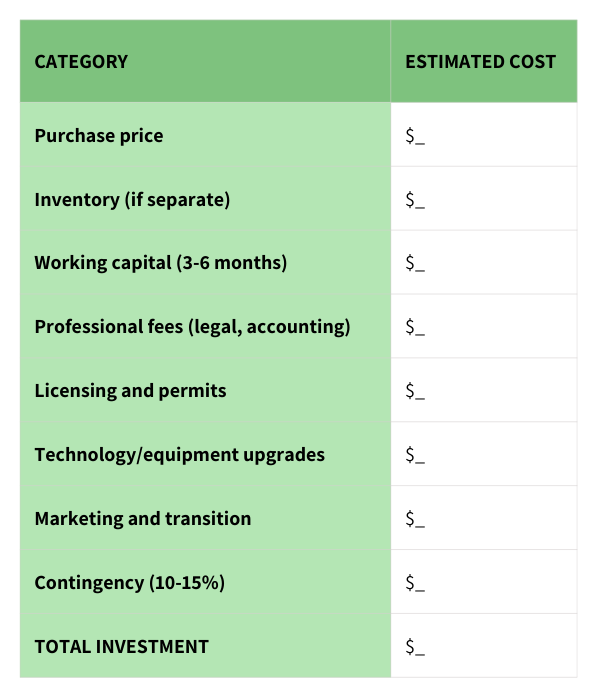
Use this framework to estimate your total investment:
Don't forget the contingency
Things will go wrong. Costs will exceed estimates. Build in a 10-15% contingency to give yourself breathing room.
Why Proof of Funds Matters: Protecting Everyone's Time
At Transworld Business Advisors of NY, we require serious buyers to provide proof of funds before beginning substantive negotiations. This isn't red tape—it's a crucial step that protects both buyers and sellers.
The reality of qualified buyers
Many buyers underestimate the total capital required for an acquisition. A buyer interested in a $500,000 business might have $50,000 saved and assume that's sufficient for a down payment. But as this guide illustrates, they actually need significantly more: funds for the down payment, working capital, professional fees, transition costs, and reserves. Without adequate capitalization, even the most motivated buyer cannot successfully complete the transaction or operate the business post-closing.
What proof of funds demonstrates
Proof of funds documentation shows that you have the financial capacity to complete the purchase and sustain operations during the critical transition period. This typically includes recent bank statements, investment account statements or documentation of committed investor capital.
Providing proof of funds demonstrates that you're a serious buyer who understands the complete financial picture. It gives sellers confidence that they're investing time with a qualified prospect, not someone who will waste months in due diligence only to discover they cannot secure financing.
Protecting your interests as a buyer
Proof of funds also protects you as a buyer. Going through the time-intensive process of due diligence, financial analysis, and negotiation only to discover you're undercapitalized is frustrating and costly. By establishing your financial capacity upfront, you can focus on businesses that genuinely fit your budget and avoid the disappointment of pursuing opportunities beyond your reach.
Serious buyers appreciate this requirement because it signals they're working with professional advisors who understand how to qualify prospects and move deals to closing efficiently. It also means the sellers you're negotiating with are committed and that your time investment is more likely to result in a successful acquisition.
In summary, the purchase price is just the first line item in your acquisition budget. Smart buyers account for working capital, inventory, transition costs, equipment needs, professional fees, and a healthy contingency before committing to a deal. Industry data consistently shows that the total cash requirement to successfully acquire and transition a business runs 25-35% higher than the purchase price alone for deals under $5 million.
By understanding the true total cost of acquisition, you'll avoid cash flow surprises that derail transitions, negotiate from a position of knowledge rather than desperation, and set your new business up for sustainable success from day one. The buyers who succeed aren't necessarily those who pay the lowest price—they're the ones who plan for the complete financial picture and enter ownership fully prepared.
Evaluating a business opportunity? Transworld Business Advisors of NY can help you understand the full financial picture—including the hidden costs that could impact your investment. Contact us for a confidential consultation.
Ready For What Comes Next on Your Entrepreneurial Journey?